
Accent wall ideas: 16 paint, wallpaper and panel looks that work
By RivAI Team · · 12 min read
The short answer
The best accent wall ideas right now are a deep, earthy paint color on the wall behind the bed or sofa, color drenching, a two-tone wall split at 36 to 42 inches, limewash or plaster for texture, board and batten or slat panels, and grasscloth or mural wallpaper. Pick the wall your eye lands on first.
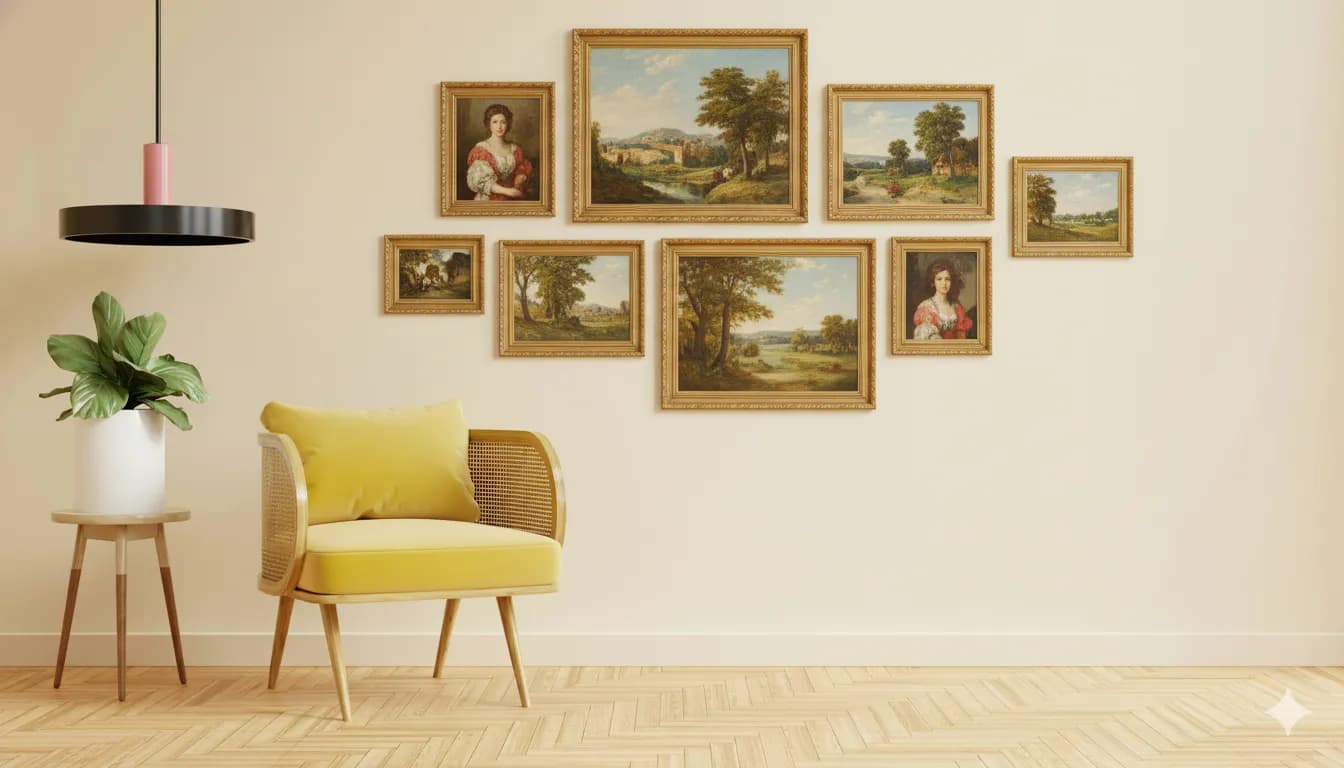
What are the best accent wall ideas?
The best accent wall ideas fall into four families: paint (a deep solid color, a two-tone split, an arch or color blocks), texture (limewash and Venetian plaster), wood (board and batten, picture-frame molding, slat panels, shiplap) and wallpaper (murals, grasscloth, large-scale prints and peel-and-stick). Paint is the cheapest to try and the easiest to undo. Wood and plaster add depth that a flat color can't, at the cost of more work.
Placement matters more than the finish. Choose the wall your eye lands on first when you walk in, which is usually the one behind the bed, the sofa, the TV or the fireplace. Skip walls chopped up by doors and windows. Go darker or more saturated than the other walls in most rooms, and keep the trim and ceiling quiet so the accent has nothing to compete with. In 2026 the random bright wall reads dated; earthy, textured and wood-clad walls don't.
Which paint ideas make the best accent wall?
Paint gives you the most looks for the least money, and it's the easiest thing to redo if you hate it. Unless noted, use eggshell on walls; save satin and semi-gloss for trim and anything that gets bumped.
1. A solid deep color on the focal wall
Start with the classic, done darker than the surrounding walls instead of brighter. Deep green, ink navy, brown and charcoal all read calm. For scale, Benjamin Moore's 2026 Color of the Year, Silhouette AF-655, is a deep brown with an LRV of 10.18, so it soaks up most of the light that hits it. Use eggshell: flat shows scuffs, and gloss shows every dent.
2. Color-drench the wall and everything on it
Drenching means one color on the wall, its trim, the baseboard, the radiator and any built-in shelves. On an accent wall it turns a busy wall with a door or a bookcase into one calm block. Put the same color in satin on the woodwork so it wipes clean, and the sheen change alone gives a quiet outline. If you love it, carry it around the whole room later.
3. A two-tone wall split at 36 to 42 in
Split the wall horizontally, darker below and lighter above, with the line 36 to 42 in (91 to 107 cm) off the floor. That's roughly chair-rail height and a rule of thumb, not a law. Higher ceilings can take a line up to about 48 in (122 cm), and lining it up with the window sills looks deliberate. A thin picture rail painted the lower color finishes the edge better than tape alone.
4. A painted arch behind the bed or desk
An arch gives you a headboard or a video-call backdrop without buying anything. Make it 6 to 12 in (15 to 30 cm) wider than the bed or desk on each side, with the top 12 to 18 in (30 to 46 cm) above the headboard. Draw the curve with a pencil tied to a string pinned at the arch's center, tape it with flexible tape and paint two coats. Deep terracotta or olive on a pale wall is the version that photographs best.
5. Geometric color blocks
Color blocking works when the shapes are big and the colors are related. Stick to two or three shades from one family, such as clay, rust and sand, and keep every shape at least 12 in (30 cm) across so the wall reads as a design instead of confetti. Run one block behind a piece of furniture so it looks anchored. Tape, burnish the edge with a credit card, and pull the tape while the last coat is still wet.
6. The ceiling as the fifth wall
When every wall is interrupted by windows, doors or built-ins, paint the ceiling instead. A warm mid-tone one or two shades deeper than the walls makes a bedroom feel enclosed and calm. Flat paint hides the bumps and patches every ceiling has. Dark ceilings suit rooms at least 8 ft (2.4 m) tall; any lower and they start to feel heavy.
Accent colors to try in 2026
Warm, earthy color is where 2026 is heading. Pittsburgh Paints' 2026 Color of the Year is Warm Mahogany, PPG1060-7, and a khaki such as Sherwin-Williams Universal Khaki (SW 6150, hex #B8A992, LRV about 40) gives a softer accent in rooms with less daylight. Treat the accent as the 10 or the 30 in a 60-30-10 color split, or pull five matching hex codes from the palette generator.
See these colors on your own walls: Try this palette in RivAI
Hex codes for the Sherwin-Williams colors come from its color pages: Tricorn Black is #2F2F30 and Pure White is #EDECE6. The green, brown, clay and navy swatches are generic, so hold a real paint chip against your screen before you buy.
How do you add texture with limewash or plaster?
7. Limewash for soft, cloudy color
Limewash is a mineral paint brushed on in loose, crisscross strokes, and it dries patchy on purpose, like old plaster. Earthy shades suit it best: mahogany, khaki, sage, clay. Plan on two coats with a wide block brush, and read the label, because most limewash needs a mineral primer to grip existing latex paint. Go corner to corner without stopping, or you'll see lap marks where one section dried first.
8. Venetian plaster or a clay finish
Venetian plaster goes on with a trowel in thin layers and gets burnished to a soft sheen, which makes it the richest texture here and the hardest to do yourself. Most finishes take two or three coats. Practice on a spare sheet of drywall first. A roman clay product gives a similar matte, stone-like look with a more forgiving technique, and it suits a fireplace wall or the wall behind a bed.
Which wood and panel walls look current?
9. Board and batten
Vertical battens over a flat wall add shadow lines and hide tired drywall. Space them every 12 to 16 in (30 to 41 cm) using 1x3 or 1x4 boards, and cap them with a flat rail at about two-thirds of the wall height, or run them all the way to the ceiling. Paint wall and battens one color in satin. Divide the wall so every gap is equal, even if that means 13.5 in instead of a round 12.
10. Picture-frame molding
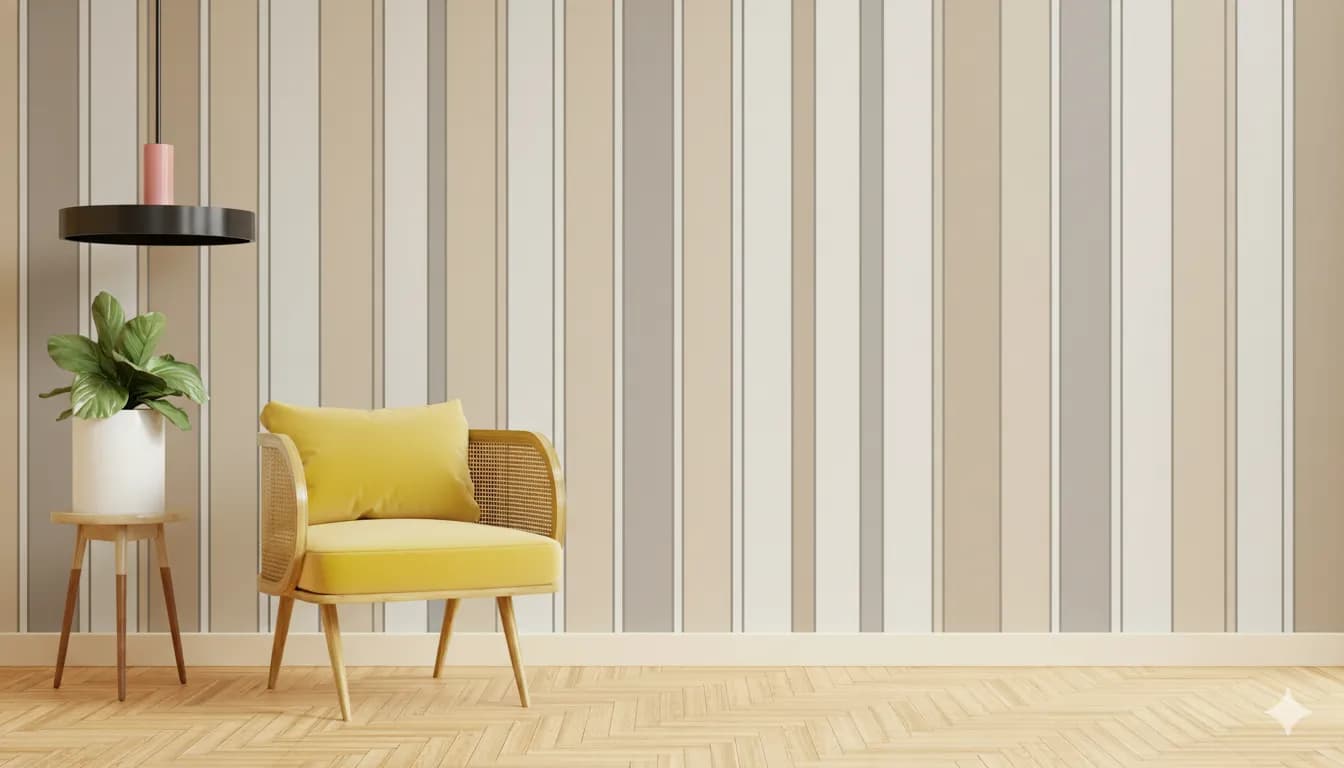
Thin molding boxes give a flat wall a Parisian feel for very little material. Keep 3 to 4 in (8 to 10 cm) between boxes and the same margin above the baseboard, and size the boxes to the furniture: one wide box centered over a sofa, two tall ones flanking a bed. Painted the same color as the wall, the molding adds shadow without adding a second color. In deep green or khaki, the gaps read as soft vertical stripes.
11. Vertical slat or fluted panels
Slat panels suit the wall behind a mounted TV. A common format is slats about 1 in (2.5 cm) wide on a felt backing with roughly 0.5 in (1.3 cm) gaps, which hides cable runs and takes a little echo out of the room. White oak reads Scandinavian, walnut reads mid-century, and black-stained slats look sharp around a dark screen. Cover the full wall height, or the panels look like an afterthought.
12. Shiplap, laid with intent
Shiplap means wide boards with a small gap, often the width of a nickel, between them. Horizontal boards make a narrow room feel wider; vertical boards make a low ceiling look taller. Run it on one wall only and paint it a real color, like khaki or forest green, instead of the all-white farmhouse version. Boards 6 to 8 in (15 to 20 cm) wide look calmer than skinny ones.
Which wallpaper works best on an accent wall?
13. A wall mural
A mural turns one wall into a view: a landscape, a botanical or a soft abstract. Pick one where the busy part sits above the furniture line, roughly 36 in (91 cm) up, so the sofa or bed doesn't slice through the main image. Order it 2 to 4 in (5 to 10 cm) wider and taller than the wall for trimming. Muted, painterly murals age better than photographic ones.
14. Grasscloth
Grasscloth is woven natural fiber on a paper backing, and it gives a wall a warm, nubby texture you notice from across the room. Seams show by nature, so treat them as part of the look. Skip it in bathrooms, kitchens and kids' rooms: it stains, and you can't scrub it. It works best behind a bed or in a quiet dining room.
15. A large-scale print or toile
Big patterns look calmer than small ones from across a room. Look for a pattern repeat of 20 in (51 cm) or more, then pull one color from it for a chair or cushions, the way a blue toile wall pairs with a yellow armchair. One wall of toile feels collected over time; four walls can feel like a hotel corridor.
16. Peel-and-stick for renters
Peel-and-stick wallpaper is the renter's accent wall. It grips smooth eggshell or satin walls best and can pull flat paint off when it comes down. Put a test strip somewhere hidden for a couple of days, then peel it before committing to the whole wall. Start from the center with a plumb line, and smooth each panel with a felt-edged squeegee.
Which accent wall ideas suit each room?
The right wall depends on what you do in the room, and on where you sit while you do it.
- Living room: the wall behind the sofa or the TV. Slat panels hide TV cables, and a deep color behind the sofa anchors the seating. Browse living room layouts and living room color ideas for pairings.
- Bedroom: the headboard wall, every time. Carry an arch, grasscloth or deep green 6 to 12 in (15 to 30 cm) past the nightstands; browse bedroom ideas or this modern bedroom for cleaner versions.
- Dining room: a two-tone split or picture-frame molding on the long wall, with scrubbable satin below the line where chairs knock it. More in dining room ideas.
- Home office: paint the wall behind your chair, since that's the one on every video call. Ink navy or a two-color block in matte keeps glare off the camera.
| Idea | Try it if | Cheapest way to test |
|---|---|---|
| Deep solid paint | the room gets decent daylight and you want a fast change | A sample pot rolled onto large poster board, taped up for a few days |
| Two-tone wall | the lower wall gets scuffed by chairs, pets or kids | A line of painter's tape at 36-42 in; live with it for a week |
| Painted arch | you have no headboard or a blank wall behind the desk | Trace the arch on kraft paper and tape it up |
| Limewash | you like soft, uneven color and old-house character | Two coats on a primed offcut of drywall |
| Board and batten | the drywall is uneven or the wall is plain | Strips of painter's tape at your batten spacing |
| Slat panels | the TV wall looks bare or cables show | Buy one panel and lean it against the wall |
| Grasscloth or mural | the wall is unbroken and you want texture or a view | A paid sample swatch taped up at eye level |
| Peel-and-stick | you rent | One test strip in a hidden spot for a couple of days |
How can you preview an accent wall on your own room?
Take one photo of the room in daylight with the whole wall in frame, and open it in RivAI on your iPhone or iPad. For wood, plaster or wallpaper, choose the Walls tool and describe the finish in plain words, such as "vertical white oak slat panels", "deep green limewash" or "blue toile wallpaper". For a straight color, the Paint tool repaints the walls in an exact shade: type a hex code from the palettes above into the iOS color picker. Standard results take about 30 seconds.
Check where the result put the finish. If the slats spread wider than the one wall you had in mind, edit that result with Replace: brush over the one wall you want and describe the finish again. The before/after slider makes the comparison quick. Free installs get 2 designs, and free results carry a watermark. Treat it as a preview of the look, not a cutting list for your battens.
What should you skip when planning an accent wall?
- A single bright wall picked at random. A lone lime or red wall on the side nobody faces is the version that dates fastest.
- Walls cut up by a door, a window and a radiator, which leave you with four small patches of color.
- High-gloss paint on old drywall. Every patch shows.
- Faux brick or stone panels that sound hollow when you knock on them.
- Small, busy wallpaper in a small room; at a distance it buzzes.
- Stacking ideas on one wall, like shiplap plus an arch plus a mural. Choose one.
FAQ
Are accent walls out of style in 2026?
The random bright wall is. A single lime or red wall on whichever side was easiest to paint looks like 2008. A deliberate wall still looks current: color drenching, limewash or plaster texture, wood slats or paneling, or good wallpaper on the wall the room already faces. Earthy, darker colors also date more slowly than bright ones.
Should an accent wall be lighter or darker?
Usually darker or more saturated than the other walls, because a deeper color pulls the eye and makes the wall look like a choice. The exception is a room that's already dark: in a deep green or navy room, a pale wall or a light limewash becomes the accent. Either way, keep trim and ceiling neutral so only one surface stands out.
What is the rule for accent walls?
Use one accent per room, on the focal wall behind the bed, sofa, TV or fireplace. Avoid walls broken up by doors or windows, and avoid the wall you walk in through. Repeat its color once or twice elsewhere, in a cushion or a print, so it looks planned.
What color is replacing gray?
Warm, earthy colors: browns, olive and forest greens, khaki and clay. That's an opinion based on where paint brands are pointing, not a measured trend. Two of the 2026 colors of the year are a deep brown and a mahogany, and khaki is taking over from greige as the easy neutral. Gray still works as a cool backdrop; it just isn't the default anymore.
Can you do an accent wall in a small room?
Yes, and a dark one often works well. Paint the wall opposite the door in a deep color with matching trim, and the corners blur so the room reads deeper. Avoid busy small-scale wallpaper in tight rooms, and keep the other walls light and plain so the accent is the only thing asking for attention.

RivAI Team
We build RivAI, the AI home design app for iPhone, at PixelPort LLC. RivAI is our product, so read our picks with that in mind: we take no payment for placements, and every product claim is checked against the app. About us · Editorial policy.
Published · Last updated
- #accent walls
- #paint ideas
- #wallpaper
- #living room
Keep reading
 Inspiration
Living room color ideas: 12 palettes with hex codes
Twelve living room color palettes with hex codes, grouped from warm neutrals to the earthy browns paint brands picked for 2026. Each one notes the light and room size it suits.
· 11 min read
 Inspiration
The 60-30-10 rule: how to split colors in any room (with palettes)
The 60-30-10 rule splits a room into a dominant, a secondary and an accent color. Here's what counts toward each share, how to build the palette, and four room palettes with hex codes.
· 11 min read
 Inspiration
10 small living room ideas that make the space feel bigger
A small living room feels bigger when you fix circulation, light and sightlines. These 10 ideas come with the exact measurements to get them right.
· 7 min read
Try this on your own room
Snap it, pick a style, see it redesigned in about 30 seconds.
Free to try · 3-day free trial on annual · Cancel anytime
