
Guide
Small room design ideas that actually work
By RivAI Team at PixelPort LLC · Published · How we write guides
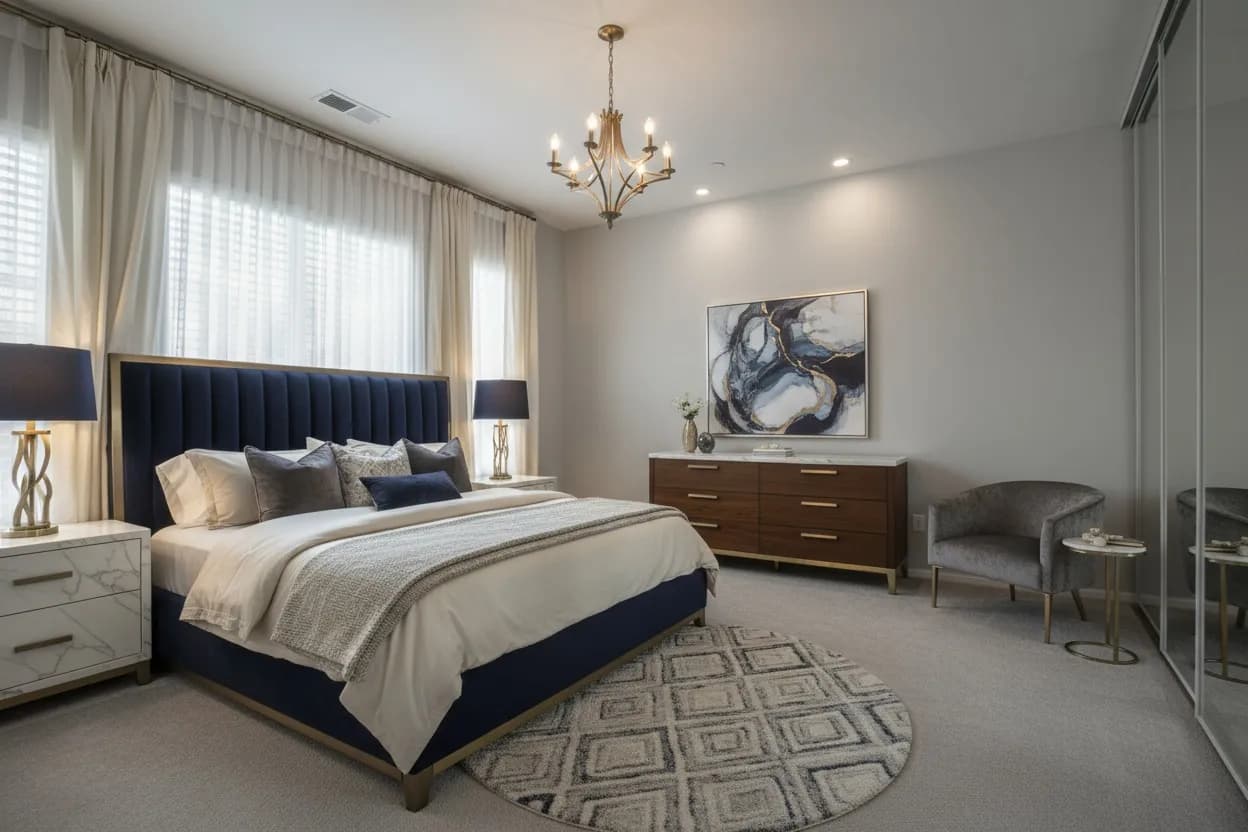
The short answerSmall rooms feel bigger when you fix layout, light and sightlines, not when you shrink the furniture. Keep walkways 30 to 36 inches wide, use wall paint with a light reflectance value above 60, choose leggy furniture that shows floor, size rugs generously, and run storage to the ceiling. Preview every idea with AI before buying.
Why do most small-room fixes fail?
The standard advice, buy smaller furniture and paint everything white, treats the symptom instead of the cause. Rooms feel small for three reasons: blocked circulation, low light reflectance, and cluttered sightlines. A room with a clear 36-inch walkway, light walls and visible floor under the furniture reads as spacious even at 10 by 10 feet. A room with dollhouse-sized furniture crammed around the edges reads as cramped at twice that size. Fix the three causes and the square footage stops mattering.
How should you lay out a small room?
Layout is free, which makes it the highest-return change you can make. The goal is one clear circulation path and furniture pulled into deliberate groups rather than pressed against every wall. Counter-intuitively, floating a sofa 10 to 15 cm off the wall makes a room feel larger, because the visible gap tricks the eye into reading more depth.
- Main walkways need 30 to 36 inches (76 to 91 cm) of clear width; 24 inches is the absolute minimum for a secondary squeeze.
- Leave 14 to 18 inches between sofa and coffee table: close enough to reach a drink, wide enough to walk through sideways.
- Keep 24 inches of clearance around a bed on the sides you use, and 36 inches at the foot if a drawer or door opens there.
- Place the largest piece first, usually the bed or sofa, on the wall that keeps the longest sightline through the room open.
- Avoid blocking windows with tall furniture; every blocked window costs you both light and the visual escape that makes rooms feel bigger.
How much do light colors and LRV matter?
Light reflectance value, or LRV, runs from 0 (pure black) to 100 (pure white) and tells you exactly how much light a paint color bounces back into the room. For small rooms, choose wall colors with an LRV of 60 or higher; below 50 the walls absorb more light than they return and the room visibly shrinks. Practical examples: a warm white like #F2EEE5 sits around LRV 80, a pale sage like #DDE3D5 around 65, and a mid-gray like #9B9B97 around 50, already too dark for a dim small room.
Paint the ceiling the same color as the walls or one step lighter, and paint trim to match rather than contrast. High-contrast trim outlines the room's boundaries like a diagram, which is exactly what you do not want in a small space. If you love a dark color, use it in a small room with excellent natural light and keep the ceiling pale, or preview it first, because dark-on-dark fails more often than it succeeds.
Which furniture makes a small room look bigger?
Visible floor is the currency of perceived space. Every piece of furniture that lets you see floor and wall underneath it pays into that currency; every skirted, floor-hugging piece spends it. This single principle drives most of the furniture choices below.
- Leggy furniture: sofas, chairs and consoles on legs 10 to 15 cm high show continuous floor and let light travel under them.
- Low-profile seating: a sofa back at 75 to 85 cm keeps sightlines over it open, which matters more than seat depth in a small room.
- Glass or acrylic tables: a transparent coffee table provides full function while taking up almost zero visual weight.
- Multi-functional pieces: a storage ottoman instead of a coffee table, a sofa bed instead of a sofa plus guest bed, a drop-leaf table instead of a fixed six-seater.
- Vertical storage: floor-to-ceiling shelving, 210 cm or taller, draws the eye up and stores more per square meter of floor than any low cabinet.
- One larger piece beats three small ones: a single generous sofa reads calmer than a loveseat plus two armchairs fighting for space.
Do mirrors really double a small room?
Not literally, but a well-placed mirror is the cheapest square footage you will ever buy. The rules are simple: hang or lean the mirror opposite or adjacent to a window so it bounces real daylight, choose the largest size the wall allows, a full-length 160 cm mirror beats a cluster of small decorative ones, and keep the frame thin or frameless so the mirror reads as an opening rather than an object. Avoid mirroring a wall that faces clutter, because a mirror doubles whatever it sees.
How does lighting change a small room?
A single overhead light flattens a small room and throws shadows into the corners, which is precisely where the eye goes to judge size. Layered lighting reclaims those corners. Aim for three sources at three heights: a ceiling or pendant light for general light, a floor or table lamp at seated eye level, and a wall sconce or LED strip for accent. Warm bulbs around 2700K keep pale walls cozy rather than clinical, and a lamp placed in the darkest corner can add a perceived meter to the room after sunset.
- Wall-mounted sconces and swing-arm lamps free up floor and table space that small rooms cannot spare.
- Choose light, open lamp shades; opaque black shades create dead zones that visually shrink the room at night.
- Put floor lamps in corners, where they wash two walls at once and push the boundaries outward.
Window treatments follow the same logic. Hang curtains from the ceiling line, not the window frame, and let them fall to the floor; this stretches the wall vertically and makes the window read as larger. Choose panels wide enough to clear the glass when open, so you keep every lumen of daylight. In truly tiny rooms, a simple roller blind in the wall color removes visual noise entirely.
What sizes actually fit? Quick reference numbers
| Element | Recommended size | Why it works |
|---|---|---|
| Main walkway | 30-36 in (76-91 cm) | Comfortable single-file circulation without brushing furniture. |
| Living room rug | 5x7 ft minimum, 8x10 ft if possible | Front legs of all seating on the rug makes the zone read as one larger area. |
| Bedroom rug | Extends 18-24 in beyond bed sides | Soft landing plus the rug visually widens the bed wall. |
| Sofa to coffee table | 14-18 in | Reachable but walkable; tighter cramps legs, wider fragments the zone. |
| Curtain rod | 4-6 in above frame, or at ceiling line | High-mounted curtains make ceilings read taller. |
| Bed side clearance | 24 in minimum | Below this you shuffle sideways and the room feels broken. |
| Dining pull-out space | 36 in behind each chair | Allows chairs to slide out and someone to pass behind. |
How do you preview these ideas before buying anything?
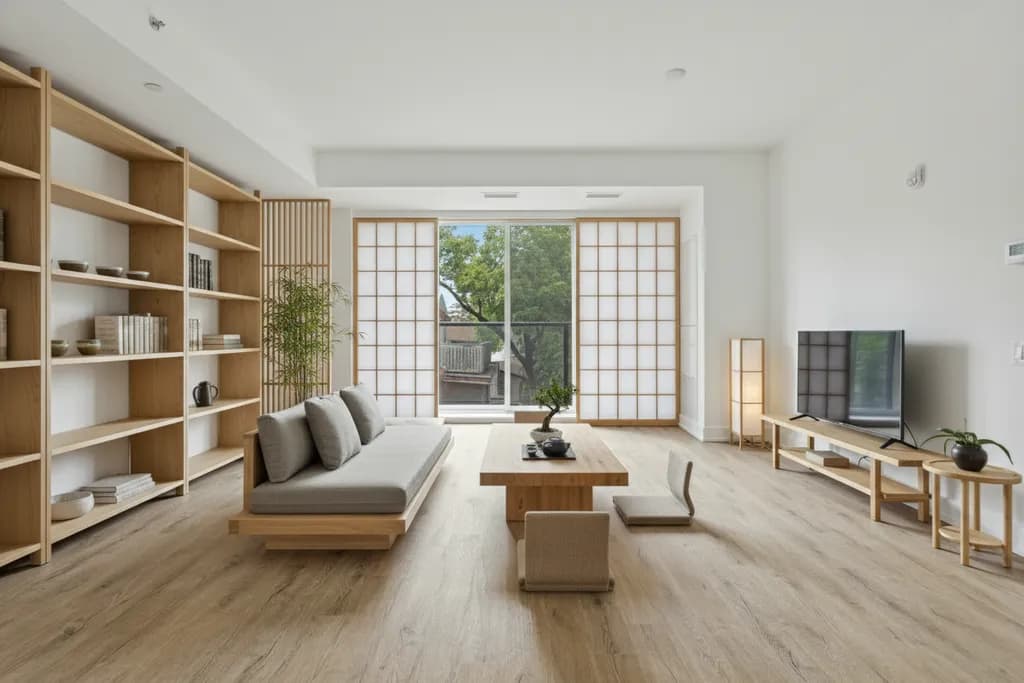
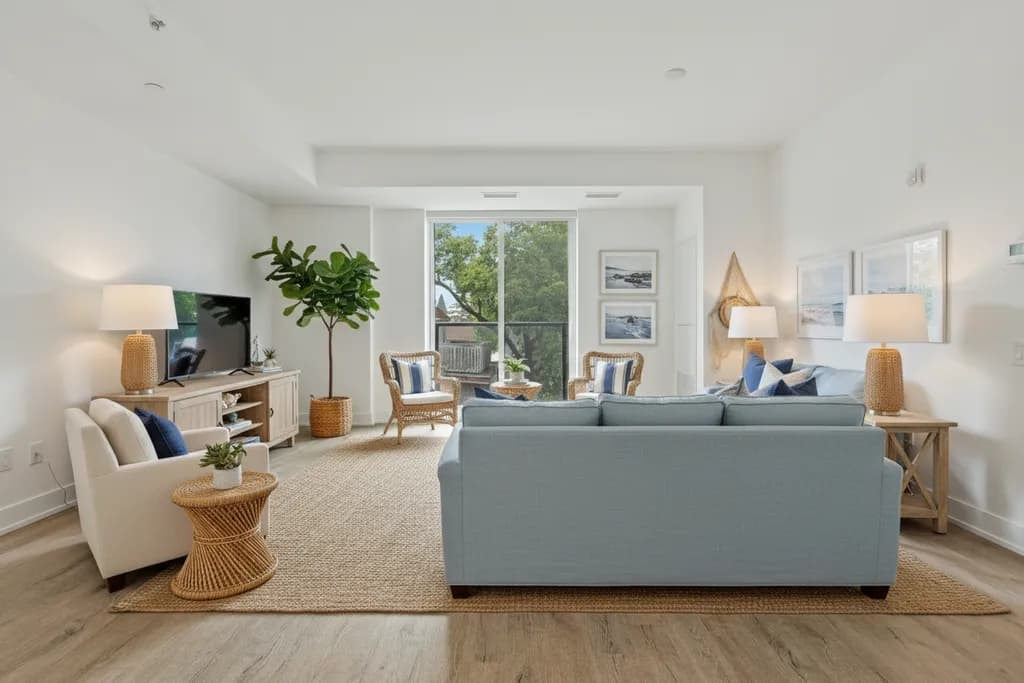
Small rooms punish mistakes because every wrong purchase is proportionally bigger. Before committing, photograph your room and test the ideas in RivAI: light walls with an exact hex color, leggy minimalist furniture, floor-to-ceiling storage, a different rug scale. The app renders a photorealistic version of your actual room in about 30 seconds on Standard, with 43 styles to choose from, and Keep Structure mode preserves your real layout so the comparison stays honest. Scandinavian, minimalist and Japanese styles are especially useful references for small rooms, since all three are built on light palettes and visible floor.
Use the before and after slider to check each idea individually: does the lighter wall color actually lift the room, does the taller bookcase overwhelm it, does the bigger rug calm it? RivAI is free to try, so you can test your first ideas before deciding on Pro, and every render you reject is a purchase you did not have to return.
Put this guide to work: small living room ideas, small bathroom ideas, studio apartment ideas and AI room planner.
Related
FAQ
What colors make a small room look bigger?
Light colors with a light reflectance value above 60: warm whites like #F2EEE5, pale grays, soft sages and muted blues. Keep the ceiling the same color or lighter and match the trim, because high-contrast outlines make small rooms feel smaller.
Should furniture in a small room be small?
Not necessarily. One properly sized sofa usually looks better than several undersized pieces, because fewer objects mean calmer sightlines. What matters is visible floor: choose pieces on legs, keep profiles low, and leave 30 to 36 inch walkways clear.
What rug size works in a small living room?
At least 5 by 7 feet, and 8 by 10 if the room allows, with the front legs of every seat on the rug. A rug that floats in the middle touching nothing visually shrinks the seating zone and, with it, the room.
Where should I put a mirror in a small room?
Opposite or beside the main window, so it reflects daylight and the view rather than a blank wall. One large mirror, full-length or wider, beats a gallery of small ones, and it should face something worth doubling, not clutter.
Can I preview small room ideas without buying furniture?
Yes. Photograph your room in RivAI, pick a style, and get a photorealistic redesign in about 30 seconds. Keep Structure mode keeps your actual layout while testing light paint colors, leggy furniture and taller storage. RivAI is free to try.
Last updated 2026-10-09
Try it on your own room
Snap it, pick a style, see it redesigned in about 30 seconds.
Free to try · 3-day free trial on annual · Cancel anytime
